11 Best Day Trips From Tel Aviv
- Jan 16
- 26 min read
Updated: Jun 1
You chose Tel Aviv as your base camp for exploring Israel? Kol hakavod — well done!
Centrally located Tel Aviv is Israel’s public transportation hub and the perfect starting point to explore most of our top attractions.
I’ve narrowed the dozens of potential Tel Aviv day trips down to the must-visit destinations, weeding out niche spots and far-flung sites that are too distant for a one-day journey.
Trips are grouped by region for easy planning. For each trip, I included step-by-step instructions for getting there by public transit, my recommended things to see and do, and restaurants where locals eat.
Tel Aviv Day Trips at a Glance
(destination | time to destination* | best for | estimated cost**)
North
Akko + Rosh HaNikra | 1.75 hrs | couples, families | ₪200–300
Carmel Ridge | 1 hr | foodies, nature lovers | ₪85–165
Nazareth + Tzipori | 2 hrs | Christians, foodies, archaeology buffs | ₪80–110
Caesarea + Zichron Yaakov | 1.25 hrs | history, garden, and wine lovers | ₪275–525
Beit She'an | 2.25 hrs | families, archaeology buffs | ₪200
Jerusalem
Old City | 1.25 hrs | everyone ages 10+ | ₪100
Mountains and Valley | 1.5 hrs | religion and archaeology buffs | ₪115
New City | 1.25 hrs | everyone ages 12+ | ₪175
South
Dead Sea | 2.5 hrs | everyone | ₪195–320
Judean Hills | 2.25 hrs | cavers + Bible nerds | ₪110
Gaza Envelope | 1.25 hrs | everyone ages 13+ | ₪100
* One way by public transit from central Tel Aviv
** Per adult, including public transit, site entrance, and activity fees. Meals not included.
North
Akko + Rosh HaNikra

This trip combines Akko’s Old City — a UNESCO World Heritage Site — with one of the Middle East’s most dramatic geologic formations, the grottoes (sea caves) of Rosh HaNikra, located at Israel’s extreme northwestern tip on the Lebanese border. 🚂 From Tel Aviv: 1 hour 45 minutes by train one way
🚋 Public transit: Easy (frequent trains and semi-frequent local buses)
👟 Walking difficulty: Easy
✨ Best for: History and geology nerds, romantic couples, and families with school-age kids 💰 Estimated cost: 200–300 shekels (₪) per adult
How to get there
Take a direct train to Nahariya from any Tel Aviv station. They leave every 10 to 60 minutes. From Nahariya station, buses 22, 24, 27, 28, or 31 go to Rosh HaNikra (20- to 30-minute ride). After your grotto tour, return to Nahariya for a 10-minute train ride south to Akko. From Akko station, take bus 271 to the Akko Bahá’í Gardens or buses 4 or 143 to the Old City.
What to do
At Rosh HaNikra, a cable car takes you down to the grottoes, a network of white limestone sea caves carved over millennia by pounding Mediterranean waves, creating cathedral-like chambers with turquoise pools and natural arches. You'll walk through illuminated tunnels where the sea crashes against the rock walls. On clear days, you can see Lebanon from the clifftop viewpoint.
Rosh HaNikra costs about ₪50 per adult — I recommend buying a ₪90 ticket that combines Rosh HaNikra with Akko’s major attractions.
If you arrive in Akko before noon, visit the local Bahá’í Gardens — not to be confused with Haifa’s beautiful Bahá’í Gardens — and the Shrine of Baháʼu'lláh, the holiest site in the Bahá’í faith. Entrance is free, but guided tours must be reserved in advance.
If you arrive in the afternoon, skip the Bahá’í Gardens and head straight to the Old City, where there are lots of attractions within a 10-minute walk of one another:
Traditional covered market (shuk in Hebrew)
1,000-year-old Crusader Knights’ Halls and palace-to-port escape tunnel
Sound and light show in the well-preserved, 18th-century hammam (Turkish bathhouse)
The Museum of Underground Prisoners (book a guided tour in advance)
Tunisian Or Torah Synagogue, with colorful mosaics and stained-glass windows
Once you’ve had your fill of history and culture, enjoy breathtaking city views from a boat ride that departs from the marina (about ₪15 per person), relax on one of the sandy beaches just south of the Old City (no entry fee), or stroll northward along the lovely promenade.
Where to eat
Akko is among Israel’s hummus capitals. Its most famous hummuseria is Hummus Said, but many locals eat at hole-in-the-wall Hummus Issa. If you prefer falafel, my favorite is Moalim.
For fancier fare, Turkiz has great brunch, Caramel is heaven for the gluten-intolerant, and seafood restaurant Uri Buri is an Akko institution.
Pro tip
Stay in Akko’s Old City until nightfall. Haifa’s majestic Bahá’í Gardens — built on the slopes of Mount Carmel directly facing Akko’s Old City — are lit up at night and truly a sight to behold. Your other half won't forget it!
Northern Carmel Ridge

Haifa, just an hour’s train ride from Tel Aviv, is Israel’s third-largest city and primary port. But it’s small enough to be combined with other stops on Mount Carmel, one of the most historically and spiritually significant places in the Middle East.
I recommend pairing Haifa with a visit to nearby Druze villages Isfiya and Daliyat al-Karmel, which have some of Israel’s best food and most spectacular views.
🚂 From Tel Aviv: An hour by train one way
🚋 Public transit: Easy (frequent trains and local buses)
👟 Walking difficulty: Moderate
✨ Best for: Foodies, nature lovers, and folks interested in obscure religions
💰 Estimated cost: ₪85–165 per adult
How to get there
Take a train to Haifa Merkaz HaShmona, then bus 58 to the HaNassi/Iris stop. Walk to the Bahá’í Gardens’ upper entrance.
After the garden tour, take bus 136 back to HaNassi/Iris and bus 58 toward Daliyat al-Karmel. Transfer to bus 1 at downtown Daliyat al-Karmel, disembark at the Daliya HaTse'ira intersection, and enjoy a half-hour, pastoral walk to the monastery.
Take buses 55 or 58 from Daliyat al-Karmel to get to Haifa’s Hecht or Tikotin museums. For the National Maritime and adjacent Clandestine Immigration and Naval museums, transfer to bus 112 at Ben Gurion/HaMeginim.
What to do
Take a free, guided tour of the Bahá’í Gardens’ upper terraces. The gardens are immaculate, the Mediterranean Sea views are breathtaking, and if you visit in the morning, you can access the interior of the Shrine of the Báb, a Bahá’í prophet. It’s best to ensure availability by booking a tour in advance.
Food is the Druze villages’ main attraction, followed by the Muhraqa Carmelite Monastery. I recommend getting food to go between bus transfers in Daliyat al-Karmel and picnicking at the monastery, located on Mount Carmel’s peak, where tradition has it that the contest between Elijah and the prophets of Baal took place. (It’s in the Bible. Look it up. 😜) Entrance is only ₪5, and the view of the Jezreel Valley is epic.

If you get back to Haifa early enough in the afternoon, visit some of Haifa’s museums. The family-friendly National Maritime and Clandestine Immigration and Naval museums have salvaged and retired ships and submarines as well as sea-themed games; the free-to-enter Hecht Museum has Monet and Modigliani paintings and the well-preserved remnants of a 2,400-year-old ship found off the coast of Northern Israel; and the Tikotin is the Middle East's only museum of Japanese culture.
Before heading back to Tel Aviv, consider taking a walk through the German Colony, a 19th-century neighborhood filled with charming cafes, or downtown Haifa, which is full of fun pubs.
Where to eat
Save your appetite for the Druze villages, known throughout Israel for exceptional food. For meat, try Shawarma 11 or Shawarma Sami. Vegetarians can enjoy stuffed grape leaves, tabbouleh, or mujaddara, a comforting lentil-and-rice dish topped with caramelized onions, at spots like Hiam’s Foods or Iman’s Kitchen.
For dessert, try pistachio ice cream and knaffeh, a warm, syrup-soaked cheese pastry, while enjoying a beautiful view at Knaffeh El Amin.
Pro tip
On Shabbat, you can take a monit sherut (shared taxi) from Tel Aviv’s Central Bus Station to Haifa, but bus transportation to the Druze villages generally stops on Shabbat and resumes on motzei Shabbat (Saturday night).
Nazareth + Tzipori

Nazareth is best known as a major Christian pilgrimage site. But its churches are visual feasts for anyone who appreciates architecture, art, and craftwork, and its cuisine is beloved by folks with a weakness for baked goods. Combining Nazareth with Tzipori, a nearby archaeological park, is a fun day trip for travelers of all backgrounds.
🚂 From Tel Aviv: Two hours by bus one way
🚋 Public transit: Challenging (infrequent buses to Tzipori)
👟 Walking difficulty: Moderate
✨ Best for: Christian pilgrims and archaeology buffs
💰 Estimated cost: ₪80–110 per adult
How to get there
Buses to Tzipori are infrequent, so renting a car is worthwhile for this trip if you have the means. If not, catch bus 826 from Tel Aviv’s Central Bus Station, Azrieli Center, or Savidor Train Station. Disembark at the Tawfiq Zayyad/Road 75 stop. From there, it’s a 15-minute walk to Nazareth’s Old City.
After you finish in Nazareth, take buses 24, 26, 28, 30, or 31 to Kafr Kana or bus 58 from Nazareth’s Central Station to the Tzipori Interchange and bus 310 from there to Tzipori National Park.
What to do

The most important things to see in Nazareth are the two main churches of Annunciation: one Catholic, the other Greek Orthodox. Both claim to be the site where the angel Gabriel appeared to the Virgin Mary and announced that she would give birth to Jesus. Entry to both is free, they're only a 10-minute walk from one another, and they're spectacular in different ways.
The Catholic Church of the Annunciation is built over Mary's childhood home. It's known for its soaring cupola — a skylight designed to resemble an inverted white Madonna lily, which grows natively in northern Israel and symbolizes Mary's purity. Another highlight is its courtyard, lined with mosaic and tile paintings of Mary submitted by various countries, each depicting her through a different cultural lens.
Between the Annunciation churches is the Old Market, filled with traditional clothing and food shops frequented by tourists and locals alike. Cooking enthusiasts should stop in Elbabour, an aromatic, family-owned spice and herb store housed in a 250-year-old stone building that preserves an antique wooden spice mill.
The Greek Orthodox Church of the Annunciation is built over Nazareth's lone spring, where, in Orthodox tradition, Mary was drawing water when Gabriel appeared. It's smaller than the Catholic church, but its collage of colorful frescoes, intricate wood carvings, and hanging lamps is mesmerizing. Christian pilgrims should also visit the Wedding Church in the Nazareth suburb of Kafr Kana, where tradition has it that Jesus performed his first miracle by turning water into wine.
If you’ve had your fill of churches, you can alternatively visit Tzipori National Park, an excavated Jewish-Roman city with remarkable mosaics, including the enigmatic “Mona Lisa of the Galilee” and an ancient synagogue mosaic depicting the Binding of Isaac.
Where to eat
Nazareth's Old City has great grub, ranging from street food to fancier sit-down spots.
Locals frequent Al-Mishhadawy Bakery for takeaway fatayer (a Middle Eastern empanada) filled with lamb or laffa flatbread with chicory greens and labneh (strained yogurt similar to cream cheese).
If you have a sweet tooth, go to Abu Ashraf and try the qatayif, a delectable fried dumpling filled with nuts or cheese. I also recommend Diana Restaurant for fresh salads, succulent meat, and excellent service.
Caesarea and Zichron Yaakov
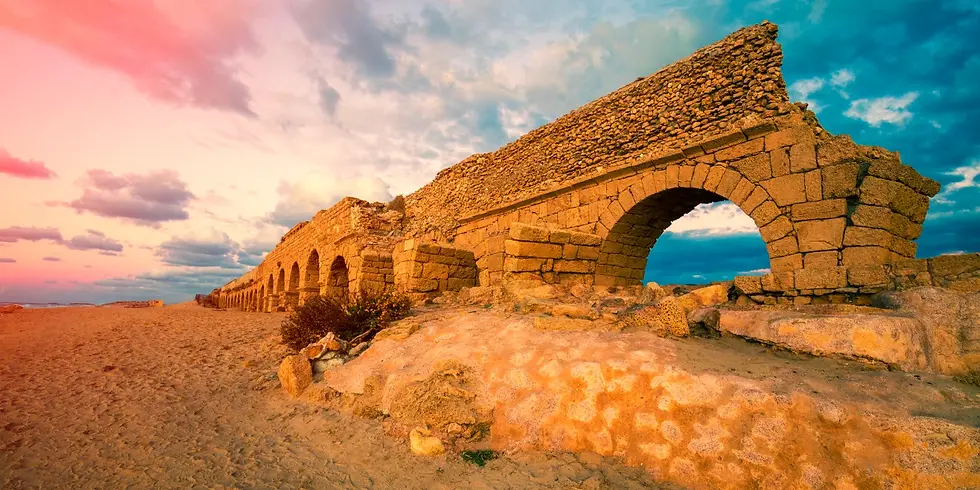
If you like Roman and Crusader history, pioneer towns, and award-winning wines, a journey along Israel's Mediterranean coastal plain and southern Carmel ridge is the perfect way to refresh your eyes and palate.
🚂 From Tel Aviv: An hour and 15 minutes to Caesarea by train and bus one way
🚋 Public transit: Challenging (infrequent buses in Caesarea)
👟 Walking difficulty: Moderate
✨ Best for: History, archaeology, garden, and wine enthusiasts; couples
💰 Estimated cost: ₪275–525 per adult
How to get there
Take a train to Binyamina, then bus 80, which runs every 90 minutes or so, to Caesarea National Park and back.
From Binyamina, continue northward on buses 70, 202, or 694 and disembark at Ort HaShomron/Road 652. Walk five minutes to the Tishbi Winery or 25 minutes along the Israel National Trail to Ramat HaNadiv.
Then backtrack to Ort HaShomron/Road 652 and ride the same buses (70, 202, or 694) to downtown Zichron Yaakov and the Carmel Winery.
What to do
Spend at least two to three hours at Caesarea National Park and its surroundings, which have Israel’s best-preserved Roman ruins, including a magnificent Roman amphitheater, an impressive aqueduct, the remains of a seafront royal palace, and the Levant’s first manmade harbor, all built 2,000 years ago by King Herod. Byzantine and Crusader-era structures, like the remarkably intact Birds Mosaic and Crusader Gate, bring subsequent chapters of Caesarea’s history to life. Wine lovers can enjoy tastings at nearby Tishbi (₪65 per person for wine and chocolate), Binyamina (₪85–₪150 per person for wine), or Margalit (₪250 per person for wine, bread, cheese, and veggies) wineries’ visitor centers. Visits are usually by appointment only.
Strolling through the meticulously maintained gardens of free-to-enter Ramat HaNadiv — the enormous burial estate of Baron Edmond de Rothschild and his wife Adelheid — makes for a refreshing and romantic break between glasses.
Continuing to Zichron Yaakov, a 19th-century town built like a rustic Romanian village, is the perfect way to finish the day. Zichron’s cobblestone main street is beautifully reconstructed and lined with historic buildings, art galleries, and the charming Ohel Yaakov synagogue. And, if you have more room for wine, one of Israel’s largest and most acclaimed wineries, Carmel, is also located in downtown Zichron. Tours are by appointment only.
Where to eat
For simple, tasty fare, try Basata Hummus near the Caesarea amphitheater or the sandwiches at the Mazalika food truck, a five-minute walk from the Binyamina Winery.
For more elevated dining, Zichron Yaakov’s Nili has good Israeli breakfast, pasta, and desserts; Caesarea’s Mariposa has excellent meat and fish.
Beit She'an

Beit She'an combines spectacular Roman ruins with refreshing natural springs in the Jordan Valley. It’s perfect for archaeology buffs and explorers of all ages who love swimming and animals.
🚂 From Tel Aviv: Two hours and 15 minutes by train and bus, one way
🚋 Public transit: Easy to challenging — only one bus goes to Gan HaShlosha every 40 minutes
👟 Walking difficulty: Easy to moderate
✨ Best for: Families with kids ages 6+
💰 Estimated cost: ₪200 per adult
How to get there
Take trains to Beit She'an, transferring at Haifa Merkaz HaShmona. Local buses connect Beit She'an’s train station to downtown; from there, it’s a 5-minute walk to Beit She'an National Park.
Bus 412 goes to Gan HaShlosha National Park and Gan Garoo.
What to do

Beit She'an National Park holds the ruins of ancient Beit She'an, one of the world's best-preserved and most extensively excavated Roman and Byzantine cities.
Highlights include its amphitheater, baths, iconic columned streets, and beautiful mosaics. You can spend anywhere from one to five hours there, depending on how much you geek out over history.
Once the Jordan Valley’s sun starts to scorch, head over to Gan HaShlosha. Its beautifully maintained natural springs have a constant temperature of 28 degrees Celsius, which feels cool in the summer and warm in the winter.
Gan Garoo, next to Gan HaShlosha, is a spacious nature park and zoo with Australian animals, mainly marsupials. You can feed and pet kangaroos and wallabies, and multicolored lory parrots will sit on your shoulders.
Where to eat
Beit She'an has tasty Israeli street food, like Zahava’s Falafel and Bar Sheshet Shawarma and Falafel. Gan HaShlosha is also perfect for a picnic.
Jerusalem
The good news is, there’s a lot to see in Jerusalem.
The bad news is, there’s a lot to see in Jerusalem — way too much for one day. So I broke it up into three day trips that explore JLM’s Old City, hilltops, and New City.
The Old City

This first JLM day trip focuses on two of the Holy City’s “big three” sites — the Western Wall and the Church of the Holy Sepulchre — with a few hidden gem spots included along the way.
The Temple Mount is saved for the next JLM day trip that explores the Old City’s periphery.
🚂 From Tel Aviv: One hour and 15 minutes by train and light rail one way
🚋 Public transit: Very easy
👟 Walking difficulty: Easy to moderate
✨ Best for: Everyone ages 10+
💰 Estimated cost: ₪200 per adult
How to get there
Jerusalem-bound trains leave from Tel Aviv every 30 to 60 minutes, depending on the time of day. The ride takes about 45 minutes.
From the Jerusalem train station, take the light rail east to the City Hall stop and walk from there to Jaffa Gate.
What to do
From Jaffa Gate, pass through the Armenian Quarter, where you can check out the hauntingly beautiful Armenian Cathedral of Saint James.

Then head eastward through the Jewish Quarter to the Cardo, an excavated Roman/Byzantine street with a free exhibition of maps depicting ancient Jerusalem. Pop into a few of Israel’s best-known synagogues, like the adjoined Four Sephardi Synagogues, the Hurva Synagogue, and the Ramban Synagogue.
Continue to the Kotel (the Western Wall), where you can easily spend an hour watching worshippers pour out their hearts in prayer. If you visit on a Monday or Thursday, you may see a festive bar mitzvah, a Jewish confirmation ceremony when families sing and dance as a sacred Torah scroll is taken from the Ark, unrolled, and chanted from in the open Kotel plaza. It’s an unforgettable spectacle.
Then, descend underground on a tour of the Kotel Tunnels, home to the closest point to the Foundation Stone — where Jews believe creation began — at which Jewish prayer is permitted
After resurfacing, head to the Lions’ Gate in the Muslim quarter. This marks the place of Jesus’ judgment and the first of 14 stations on the Via Dolorosa (“the Way of Suffering” in Latin), the route Jesus took to his crucifixion. You can retrace the story of Jesus’ last day by walking part of the route, which ultimately ends at the Church of the Holy Sepulchre, the world’s most sacred place for Christians and site of the final five Via Dolorosa stations.
On a personal note, when you study to become a licensed Israeli tour guide, the Church of the Holy Sepulchre takes up two full days of lectures. The professor meets us at 7 a.m. and lectures until 4 p.m. with just a lunch break, for two straight days. That's how rich and complex Jerusalem’s major sites are.
Where to eat
Stick to little family-run spots:
Al-Baghdadi Restaurant for killer kebabs
Rewined JLM for quality Armenian and Italian cuisine
Patisserie Jack for coffee and cake
Lina for hole-in-the-wall hummus
Pro tip
On Shabbat, you can take a monit sherut from Tel Aviv’s Central Bus Station. Ask to be dropped off as close to the Old City as possible.
Mountains and Valley

The hills and valleys surrounding Jerusalem's Old City hold some of the most sacred and historically significant sites in Judaism, Christianity, and Islam — from King David's Tomb to the Mount of Olives to the Dome of the Rock — where kings, prophets, and pilgrims have walked for millennia.
🚂 From Tel Aviv: 90 minutes by train and bus one way
🚋 Public transit: Very easy
👟 Walking difficulty: Moderate
✨ Best for: History and archaeology enthusiasts, Jewish and Christian travelers, and families with kids ages 11+
💰 Estimated cost: ₪115 per adult
How to get there
From the Central Station/Yafo bus stop outside Jerusalem's train station, take bus 1 heading east. Disembark at Jericho Road/HaOfel Road and walk 15 minutes to the Rechavam Observation Point, which offers the most spectacular view of Jerusalem.
What to do
After taking in the view of the Old City from the Mount of Olives, walk downhill on the Pilgrims' Route, passing through the world's most important Jewish cemetery. It's 3,000 years old and still functioning.

Then visit two of the area's many churches: first, a church built like a teardrop, called Dominus Flevit, where tradition tells us Jesus wept when he saw the Temple and prophesied its destruction. The road continues downward to Gethsemane, the garden where Jesus was captured by the police. The adjacent Basilica of All Nations is one of the most impressive churches in Jerusalem.
The road continues to the bottom of the Kidron Valley — "koder" in Hebrew means "gloomy" — where you can see some of the 2,000-year-old monumental rock-cut tombs of important Jewish families during the Second Temple period. They're known today as the tombs of Absalom and Zechariah.
From there, head uphill to the top of Mount Moriah and enter the Temple Mount via the Mughrabi ramp/bridge. The Temple Mount Plaza holds the golden Dome of the Rock. Take lots of pictures!
Exit the Temple Mount into the Western Wall Plaza and break for lunch in the Jewish Quarter. Finish the day by walking to Mount Zion. The main sites there are King David’s Tomb, the Hall of the Last Supper, and regal Dormition Abbey, where, in Catholic tradition, the Virgin Mary ascended to heaven.
Where to eat
Good places to eat in the Jewish Quarter include:
Between the Arches, located in a 13th-century stone building, for atmosphere
Seoul House for kosher Korean cuisine (yes, it’s a thing)
Pro tip
The Temple Mount is generally open Sunday through Thursday from 7:00 a.m. to 11:30 a.m. and 1:30 p.m. to 3:00 p.m. in the summer and 07:00 a.m. to 11:00 a.m. and 12:30 p.m. to 2:00 p.m. in the winter.
Review the Temple Mount behavior guidelines and context to ensure a safe visit.
The New City

Outside the Old City walls is the New City, home to bustling markets, world-class museums, and powerful memorials — a side of Jerusalem that's just as essential to understanding Israel as the Old City’s ancient stones.
In this day trip, you'll confront Jewish history’s darkest chapter at Yad Vashem, experience the vibrant chaos of Mahane Yehuda Market, and explore the Israel Museum's millennia of art and archaeology.
🚂 From Tel Aviv: One hour and 15 minutes by train and light rail one way
🚋 Public transit: Easy
👟 Walking difficulty: Easy to moderate
✨ Best for: Everyone ages 12+ 💰 Estimated cost: ₪175 per adult
How to get there
From the Jerusalem train station, take the light rail heading southwest (toward Hadassah Ein Kerem) and disembark at the Mount Herzl station. It’s a 10-minute walk from there to Yad Vashem and Mount Herzl.
To get to Mahane Yehuda Market, backtrack to the light rail, take it heading northeast (toward Neve Ya’akov), and disembark at Mahane Yehuda station.
To get to the Israel Museum from Mahane Yehuda, walk down to the Bezalel/Nissim Behar bus stop and take bus 7 heading west. Disembark at Israel Museum/Wise.
What to do
Yad Vashem, the world's largest Holocaust institution, combines a comprehensive historical museum tracing the rise of Nazism and the murder of European Jewry alongside deeply moving memorial spaces, like the Children’s Memorial — a dark, mirrored chamber illuminated by candlelight and the recorded names of murdered children — and the Hall of Names — a soaring circular archive that preserves personal testimonies and photographs in remembrance of Holocaust victims.
It takes about three hours to see the museum and main memorials with an audio guide or on a guided tour. Both cost about ₪45 per adult and should be reserved in advance.
Yad Vashem is one half of Mount Herzl. The other half is our national cemetery, where most of Israel’s fallen soldiers and many other national heroes — like Yitzhak Rabin, Golda Meir, and the mountain’s namesake, Theodore Herzl — are buried. Their graves are also worth visiting.

After a lunch break at Mahane Yehuda Market, continue to the Israel Museum, where you can spend anywhere from three hours to three days. It's one of the biggest museums in the world, and it has a jaw-dropping collection of Middle Eastern artifacts, Judaica, national costumes, classical art, and modern art.
Going with a guide — who can curate the museum tour to suit your personal interests — is strongly advised.
But if you go on a self-guided tour, don’t miss:
The detailed 1:50 scale model of ancient Jerusalem as it stood 2,000 years ago
The Dead Sea Scrolls, the oldest copy of the Hebrew Bible ever discovered
The sarcophagus of King Herod the Great — the guy who built Masada, Caesarea, and the massive Second Temple complex
Rembrandt’s masterpiece painting, St. Peter in Prison
Four synagogues transported in their entirety from Surinam, India, Germany, and Italy
Israel Museum entrance costs ₪62 per adult.
Where to eat
Mahane Yehuda, which doubles as a traditional shuk by day and Jerusalem’s lively social hotspot by night, has Israel’s highest concentration of food stalls, bakeries, coffee shops, bars, and chef-driven restaurants in one walkable area. So come hungry, and let your sense of smell direct you to the eatery of your choice.
If you have trouble choosing, consider:
Azura for Israeli-Kurdish kubeh soup — beef-filled semolina and bulgur wheat dumplings in heavenly beet, pumpkin, or lemon-chard-celery broths
Aricha for sabich, an Israeli-Iraqi pita sandwich with fried eggplant, hard-boiled eggs, veggies, and mango pickle sauce
Arais, an Israeli place that kids love, for minced meat baked in pita
Hatzot for traditional Israeli salads and skewered meats
Marzipan Bakery for mouthwatering rugelach (Ashkenazi chocolate croissants)
Read more: Best Rainy-Day Museums in Jerusalem
South
The Dead Sea, Masada, and Ein Gedi

This day trip combines the Judean Desert’s three most dramatic landscapes: an ancient mountaintop fortress where Jewish rebels made their last stand against Rome, a lush oasis waterfall, and the lowest point on Earth.
🚂 From Tel Aviv: Two and a half hours by train and bus one way
🚋 Public transit: Car recommended
👟 Walking difficulty: Easy to strenuous
✨ Best for: Everyone ages 8+
💰 Estimated cost: ₪195 to ₪320 per adult
How to get there
Public buses go to the Dead Sea, Masada, and Ein Gedi. But connections between the sites are limited, making it difficult to hit all three in one day without private transportation. So, for this day trip, I recommend renting a car or hiring a tour guide to organize your transportation and itinerary from start to finish.
If that’s financially prohibitive and public transit is your only option, consider breaking the sites up into multiple days rather than cramming them into one.
To get to Masada, Ein Gedi, and the Dead Sea with public transit, take the train from Tel Aviv to Jerusalem, then cross Jaffa Street and enter the Central Bus Station. Go up to the third floor and take buses 444 or 486, which usually depart every 15 minutes. Ask the driver to drop you off at Masada. The same bus lines can be taken in the reverse direction to stop at Ein Gedi and the Dead Sea’s Kalia Beach.
What to do
Start your day early at Masada National Park, where Jewish rebels made their legendary last stand against the Romans in 73 CE.
Arriving at the crack of dawn means you'll beat the heat and enjoy Israel's most epic sunrise atop this ancient fortress plateau. You can hike to the top via the Snake Path (about 90 minutes going up and 45 minutes walking down) or take the cable car if you prefer. Entry costs ₪37 per adult via the Snake Path and ₪91 per adult via the cable car (round trip).
At the summit, explore King Herod's remarkably preserved palace complex, storerooms, bathhouse with original mosaic floors, and synagogue. The panoramic views of the Judean Desert and Dead Sea are breathtaking.
Next, head to Ein Gedi Nature Reserve (₪31 per adult), a desert oasis where freshwater springs create lush waterfalls and pools amid the arid landscape. The most popular trail leads to David's Waterfall (about 90 minutes round trip, moderate hiking difficulty), where you can stand under the cascading water for a refreshing break from the desert heat. Keep your eyes and ears open for Nubian ibex and singing rock hyrax that call this reserve home.
After these more active adventures, you'll be ready to float lazily in the Dead Sea's mineral-rich, hyper-saline waters — the lowest point on Earth at about 440 meters below sea level.
The Dead Sea has many nice beaches. I recommend Kalia Beach (₪45 per adult for all-inclusive admission) and Neve Midbar Beach (₪70), located next to one another at the Dead Sea’s northwest corner. Both have lockers, changing rooms, showers, and plenty of skin-enriching mud.
Where to eat

Salty, a Greek restaurant at Kalia Beach, has great options for fish-, meat-, and veggie-lovers alike. But it’s open only on Thursday evening, Friday, and Saturday.
The other option at Kalia Beach, accurately entitled the Lowest Bar in the World, is a decent backup if you’re visiting on a weekday.
If you have a car, Cafécito — open Thursday, Friday, and Saturday — is a must-stop food truck for coffee and dessert on the way back from Masada or En Gedi.
Pro tip
Don’t put your head underwater in the Dead Sea, and avoid entering the water if you have a sunburn, cuts, or have recently shaved. The extreme salinity can irritate the eyes and skin.
Judean Hills

Home to the epic Valley of Elah and some jaw-dropping cave systems, the Judean Hills is one of Israel’s most scenic regions. It’s a pastoral mix of biblical history and natural splendor.
🚂 From Tel Aviv: 2.25 hours by train and bus one way
🚋 Public transit: Car recommended
👟 Walking difficulty: Moderate
✨ Best for: Bible and Jewish history lovers, archaeology enthusiasts, and families with kids ages 8+
💰 Estimated cost: ₪110
How to get there
This is another day trip in rural Israel, where it’s best to rent a car. But it’s doable by public transit if you’re adventure-minded.
Start by taking a train from Tel Aviv to Beit Shemesh. From the Beit Shemesh train station, take bus 324, which departs once hourly. Tell the driver that you’d like to disembark at Azekah Junction (Tzomet Azekah in Hebrew). Then walk about one mile along the Israel National Trail until you reach Tel Azekah, which overlooks the Valley of Elah.
After you’ve finished taking in the atmosphere at Tel Azekah, walk south for about 20 minutes until you reach a parking lot (the sign says חניון בור המים in Hebrew), then veer left and walk southeast toward Route 38 until you reach HaElah Junction. Take buses 324 or 132 to Beit Guvrin Junction West, then walk 15 minutes to Beit Guvrin-Maresha National Park.
What to do
Tel Azekah and the Valley of Elah are rich in biblical and Jewish history.
The Valley of Elah is where David fought Goliath in the Book of Samuel. Azekah was one of the final Judean towns conquered by Nebuchadnezzar before the Babylonian exile and is listed in the Book of Nehemiah as one of the towns reinhabited by Jews upon their return from Babylon. Today, the rustic area is perfect for gentle hikes and picnics.

Beit Guvrin-Maresha National Park is like Disneyland for archaeology nerds and adventurers.
Its cave systems include adrenaline-inducing, crawling-room-only caves; elaborately painted, 2,000+-year-old Sidonian burial caves; columbaria caves, where doves were kept for food; and jaw-dropping caverns high enough to fit a three-story building inside.
In addition to the caves, the area also has a large Roman amphitheatre and the ruins of the Crusader-era Church of Saint Anne.
Where to eat
Good restaurants are limited in this part of Israel, so it’s best to come with sandwiches and snacks. You can have a picturesque picnic at Tel Azekah or outside the Beit Guvrin caves.
Gaza Envelope

This isn’t a pleasant day trip. But it’s a necessary one.
🚂 From Tel Aviv: 1.25 hours by train one way
🚋 Public transit: Car recommended
👟 Walking difficulty: Easy
✨ Best for: Everyone ages 14+
💰 Estimated cost: Less than ₪100
How to get there
Take a train to Sderot. They leave every 30 minutes from the Tel Aviv stations. It’s a 15-minute walk from the Sderot train station to the Heroism Memorial Garden. From there, it’s another 15-minute walk to the memorial for murdered senior citizens.
After paying your respects in Sderot, take buses 36, 136, 379, or 495 heading south from the Sderot train station. These take Route 232, which has sometimes been referred to as Kvish HaDamim (“the Highway of Blood”) in Israel since the October 7 attacks. The Nova Festival Victims Memorial is about a 20-minute walk northwest from the Re'im Junction bus stop on this road.
Alternatively, you can take buses 353 or 361 from Sderot to the Netivot Junction/Weizman Avenue bus stop outside Tkuma and then walk five minutes northwest to the Car Wall.
Note that buses run infrequently in the Gaza Envelope, and there’s no direct bus between Tkuma and Re'im, so it’s worth renting a car if you can.
What to do
The Heroism Memorial Garden was built on the site of the former Sderot police station, where dozens of police officers gave their lives in a 28-hour fight against Hamas terrorists who occupied the building and murdered unknowing civilians seeking sanctuary in the early hours of October 7. The memorial consists of the 36-foot-high Pillars of Eternity, haunting audio recordings of desperate calls made to and from the police that day, and two colorful murals — one depicting the people of Israel as lions; the other the letters of a Torah scroll rising into the sky.

A smaller memorial, across the street from the Sderot Municipal Library, where terrorists murdered 13 senior citizens riding a minibus on their way to visit the Dead Sea, is also worth visiting if you have time.
South of Sderot is the Car Wall, a pile of thousands of bullet-riddled and burned vehicles that were removed from the various October 7 massacre sites to clear the areas for recovery and investigation. Select vehicles — like the aforementioned senior citizens’ minibus — have barcodes you can scan to learn about their occupants’ fate.
But perhaps the most heartbreaking October 7 memorial stands near Kibbutz Re'im, site of the Nova Music Festival massacre — the deadliest perpetrated that day. Its victims are memorialized with tree-like posts bearing their photos and ceramic mini-sculptures of red poppy anemones, Israel’s national flower.
Where to eat
Sderot’s Tahini Hummus is famous throughout Israel for its hummus and falafel. Kuli’s Truck, off Route 232, is a food truck known for its schnitzel sandwiches.
Guided Day Tours from Tel Aviv
All of the day trips above can be done independently.
But many travelers choose guided day tours from Tel Aviv — especially when time is limited, logistics are complex, and you want the day to be truly meaningful.
Israel's layered past and present aren't fully captured in park and museum brochures. Without guidance, Jerusalem's Old City feels like a cobblestone maze rather than the world's most spiritually charged square kilometer. The Valley of Elah becomes pretty green fields rather than the place where a shepherd boy became king. The Gaza Envelope seems like a series of tragedies rather than a living testament to resilience and renewal.
A knowledgeable guide brings context, local perspective, and access that transforms sightseeing into understanding — and handles all the timing and logistics while you focus solely on the experience. If you'd like to experience Israel with expert guidance, reach out to me and I'll design an unforgettable day tour from Tel Aviv tailored to your interests and schedule.
FAQ
What is a day trip?
A day trip is a journey to a destination that can be completed in a single day, without an overnight stay. For this guide to the best day trips from Tel Aviv, I've included only destinations within 2.5 hours of Tel Aviv by public transit, one way. Destinations farther afield, like the Golan Heights or Eilat, are better suited to multi-day trips.
What should I pack for a day trip in Israel?
For most day trips in Israel, it’s best to pack light but plan for sun, walking, and changing conditions. Essentials include:
Comfortable walking shoes
Water
Sun protection (hat, sunscreen, sunglasses)
Swimwear and a towel
A light layer for air-conditioned buses, caves, and cooler evenings
Phone, charger or power bank, and a payment method for public transportation
Modest clothing covering shoulders and knees for religious sites. What’s so exciting about shoulders and knees? I don’t know. But there it is.
How do I pay for public transportation in Israel?
Israel’s public transportation is mostly cashless, and bus drivers typically don’t issue tickets. So, if you plan to use our public transit repeatedly, you should either:
Buy a Rav-Kav, Israel’s public transportation card, for about five shekels at Ben Gurion Airport, train stations, or tourist information centers. You can load your Rav-Kav with credit or travel passes and use it on buses, trains, and light rail throughout Israel.
Use a mobile app like Moovit, which tracks your rides and charges you automatically, applying fare caps so you pay the lowest possible price.
Single train and light rail tickets can also be purchased at station ticket machines, and intercity bus tickets can be purchased at central bus stations in major cities like Tel Aviv or Jerusalem. But most travelers find Rav-Kav or Moovit more convenient.
Do buses run on Saturday in Israel?
Public transportation in Israel largely shuts down on Saturday (Shabbat), including trains and most buses. But there are some exceptions: Cities that are mostly secular or have significant Arab communities, like Tel Aviv and Haifa, offer limited Saturday bus service.
To travel between major cities on Saturday, many Israelis use moniot sherut — shared taxis. But note that moniot sherut usually require cash — you can’t pay for them with a credit card, Rav Kav, or Moovit.
Should I rent a car in Israel?
You should consider renting a car in Israel if:
You plan to travel on Shabbat, when Israel’s trains don’t run and bus service is limited.
You’re traveling with senior citizens or kids, who may be unable to walk long distances or may not have the patience to wait for public transit.
You plan to travel in rural areas of Israel, like the Dead Sea, the Valley of Elah, or Caesarea. The distance between points of interest in these areas is longer than in major metropolitan areas, making public transit less feasible for a day trip.
How much does it cost to visit a national park in Israel?
Ticket prices for Israel’s national parks range from about 15 to 45 shekels for adults and 5 to 30 shekels for children and seniors.
Groups of 30+ people get discounted rates. You can also save money with a multi-park pass valid for two weeks.
I’ve already been to all these destinations. Do you have any other ideas?
Yes! This guide highlights the most popular day trips from Tel Aviv, but there are dozens of lesser-known destinations worth exploring if you’ve already visited the classics.
If you’d like fresh ideas tailored to your interests and schedule, reach out to me and I’ll gladly suggest a few options.
About the Author
Karl Walter is a licensed Israeli tour guide with over 30 years of experience leading thousands of travelers across the country he calls home.
A trained botanist, polyglot, and cave crawler, he combines deep knowledge of Israel’s history, culture, and landscapes to craft highly personalized, unforgettable journeys.

Comments